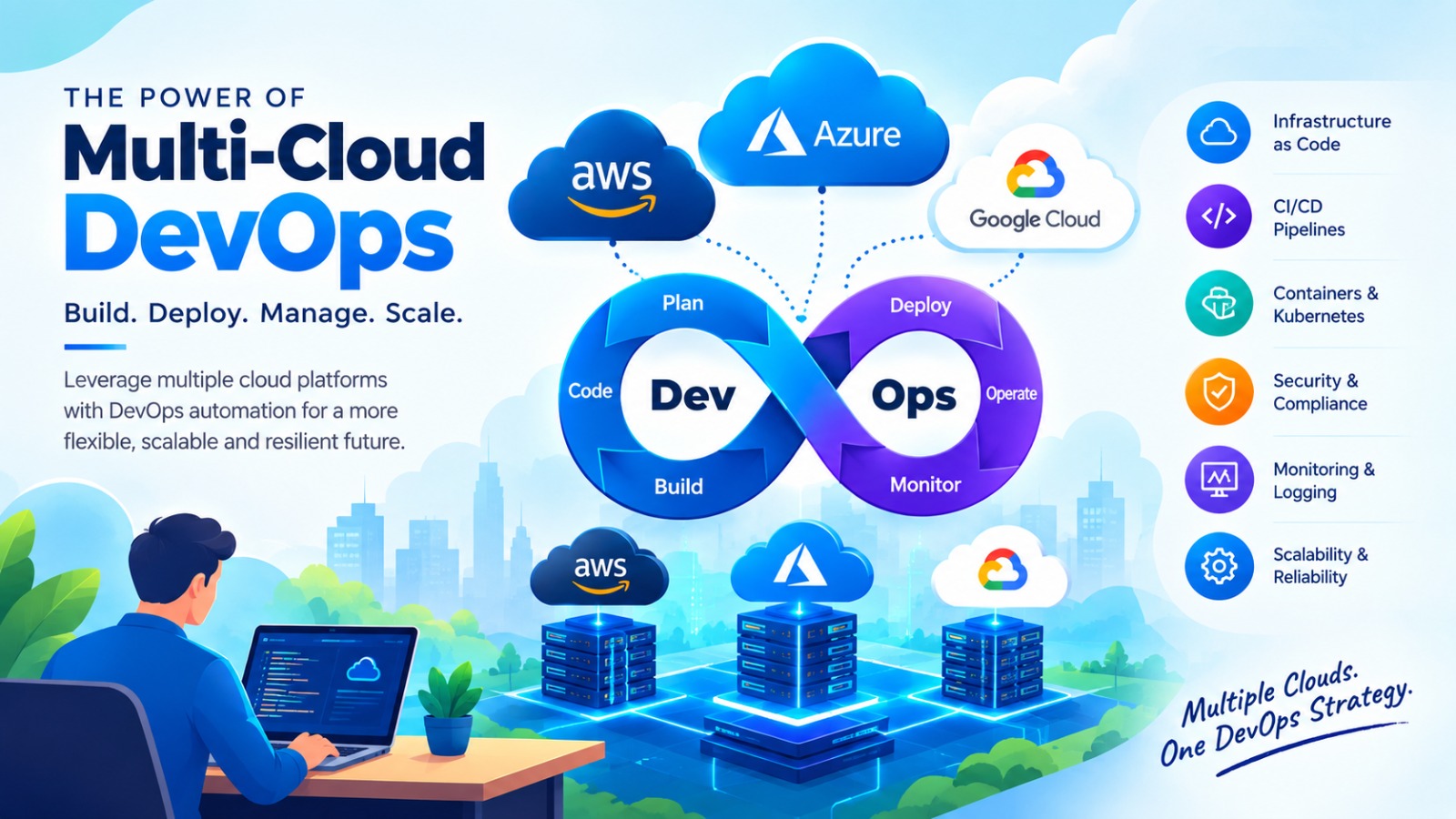
Multi-Cloud DevOps: Complete Guide to Modern Cloud Automation
Cloud computing has become an essential part of modern business infrastructure. Organizations today are increasingly using cloud platforms to develop, deploy, scale, and manage applications. While many businesses initially relied on a single cloud provider, the growing need for flexibility, scalability, reliability, and specialized cloud services has increased the adoption of multi-cloud environments.
This is where Multi-Cloud DevOps plays an important role.
Multi-Cloud DevOps combines DevOps practices with multiple cloud platforms such as Amazon Web Services (AWS), Microsoft Azure, and Google Cloud Platform (GCP). It enables organizations to automate infrastructure, application deployment, monitoring, security, and operations across different cloud environments.
For students, IT professionals, and aspiring DevOps engineers, learning Multi-Cloud DevOps can provide practical exposure to some of the technologies used in modern cloud infrastructure.
What is Multi-Cloud DevOps?
Multi-Cloud DevOps refers to the implementation of DevOps practices across two or more cloud platforms.
Instead of depending on only one cloud provider, an organization may use AWS, Azure, and Google Cloud for different applications, services, or workloads.
For example:
- AWS can be used for application hosting.
- Azure can be used for enterprise applications and Microsoft-based workloads.
- Google Cloud can be used for analytics and data-intensive workloads.
- Kubernetes can be used to manage containerized applications.
- Terraform can be used to automate infrastructure across multiple cloud providers.
- Jenkins or GitHub Actions can automate application build and deployment processes.
The objective is to create a consistent, automated, and manageable DevOps workflow across multiple cloud environments.
Why Are Organizations Adopting Multi-Cloud Strategies?
The cloud environment is continuously evolving, and organizations have different infrastructure and application requirements. A multi-cloud approach provides flexibility in choosing cloud services according to specific business and technical needs.
1. Greater Flexibility
Different cloud providers offer different services and capabilities. Using multiple platforms allows organizations to select suitable services for particular workloads.
2. Reduced Dependency on One Provider
A multi-cloud strategy can reduce dependence on a single cloud provider and give organizations greater flexibility when planning their infrastructure.
3. Scalability
Cloud platforms allow organizations to increase or decrease infrastructure resources according to application requirements. DevOps automation makes this process more efficient.
4. Improved Resilience
Organizations can design appropriate redundancy and disaster-recovery strategies across cloud environments to improve business continuity.
5. Access to Specialized Cloud Services
Each cloud platform has its own ecosystem of services. Organizations may use different providers when particular cloud capabilities better fit their technical requirements.
Multi-Cloud DevOps vs Traditional DevOps
Traditional DevOps may operate primarily within one infrastructure or cloud environment. Multi-Cloud DevOps extends these practices across several cloud platforms.
A traditional workflow may look like:
Developer → Git → CI/CD → Cloud Platform → Application → Monitoring
A multi-cloud workflow can look like:
Developer → Git → CI/CD → Terraform → AWS + Azure + Google Cloud → Kubernetes → Monitoring
This makes automation and standardization particularly important because teams need to manage different cloud environments efficiently.
Key Technologies Used in Multi-Cloud DevOps
A Multi-Cloud DevOps engineer typically works with several technologies. Understanding how these tools work together is more important than learning them individually.
AWS, Azure, and Google Cloud
The three major cloud platforms provide infrastructure, compute, storage, networking, databases, security services, and other cloud capabilities.
Learning the fundamentals of all three platforms can help DevOps professionals understand how cloud environments differ and how common DevOps principles can be applied across them.
Git and GitHub
Git is a distributed version-control system used to track source-code changes.
GitHub provides a collaborative platform for hosting repositories, managing code, reviewing changes, and integrating development workflows.
Version control is a fundamental component of modern DevOps pipelines.
Jenkins and CI/CD
Continuous Integration and Continuous Delivery/Deployment help automate the software development lifecycle.
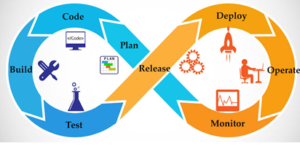
A typical CI/CD pipeline can include:
- Code commit
- Source-code checkout
- Build
- Testing
- Security scanning
- Artifact creation
- Deployment
- Monitoring
Jenkins is one of the widely used automation servers for creating CI/CD pipelines.
Other technologies such as GitHub Actions, GitLab CI/CD, and Azure DevOps can also be used to automate software delivery.
Docker
Docker allows applications and their dependencies to be packaged into containers.
Containers help provide consistency between development, testing, and production environments.
For multi-cloud environments, containerization can simplify application deployment because containerized workloads can run across different infrastructure platforms.
Kubernetes
Kubernetes is a container orchestration platform used to deploy, scale, and manage containerized applications.
Managed Kubernetes services include:
- Amazon Elastic Kubernetes Service (EKS)
- Azure Kubernetes Service (AKS)
- Google Kubernetes Engine (GKE)
Kubernetes is therefore an important technology for professionals working with modern cloud-native and multi-cloud environments.
Terraform
Infrastructure as Code, or IaC, allows infrastructure to be defined using configuration files.
Terraform is commonly used to provision and manage infrastructure across multiple cloud providers.
For example, a DevOps engineer can use Terraform to automate infrastructure resources across AWS and Azure while maintaining infrastructure configurations as code.
This reduces repetitive manual work and supports more consistent infrastructure deployment.
Ansible
Ansible is an automation and configuration-management tool.
It can be used to automate tasks such as:
- Server configuration
- Application deployment
- Package installation
- Configuration updates
- Infrastructure operations
Ansible can complement Terraform by handling configuration and operational automation after infrastructure has been provisioned.
Infrastructure as Code in Multi-Cloud DevOps
Infrastructure as Code is one of the most important concepts in Multi-Cloud DevOps.
Instead of manually creating cloud resources, engineers define infrastructure through code.
For example, infrastructure can include:
- Virtual machines
- Networks
- Security groups
- Load balancers
- Databases
- Kubernetes clusters
- Storage resources
Using IaC provides repeatability and makes infrastructure changes easier to track through version control.
Terraform is particularly useful when teams need to manage infrastructure across multiple cloud providers.
CI/CD in a Multi-Cloud Environment
CI/CD pipelines help organizations automate application delivery.
Consider an application that needs to be deployed across AWS and Azure.
A pipeline could perform the following activities:
Code Commit → Build → Test → Security Scan → Container Build → Push Image → Deploy → Monitor
The same pipeline can be designed to deploy applications to different environments depending on business requirements.
This reduces manual deployment work and provides a repeatable software delivery process.
Kubernetes and Multi-Cloud Architecture
Kubernetes is increasingly important in cloud-native environments.
Organizations can use managed Kubernetes services such as EKS, AKS, and GKE. A DevOps team can apply Kubernetes concepts such as:
- Pods
- Deployments
- Services
- ConfigMaps
- Secrets
- Ingress
- Namespaces
- Horizontal Pod Autoscaling
Understanding Kubernetes networking, storage, deployments, and troubleshooting can be particularly valuable for professionals working with distributed cloud applications.
Monitoring and Logging
Managing multiple cloud platforms requires effective monitoring.
DevOps teams need visibility into:
- Application performance
- Infrastructure health
- Resource utilization
- Network performance
- Deployment status
- Errors and failures
- Security events
Popular monitoring and observability technologies include Prometheus, Grafana, ELK Stack, and OpenTelemetry, along with monitoring services provided by individual cloud platforms.
Centralized logging and monitoring can make troubleshooting easier when applications are distributed across multiple environments.
Security in Multi-Cloud DevOps
Security should be incorporated throughout the DevOps lifecycle.
Important areas include:
Identity and Access Management
Access should be controlled using appropriate roles and permissions.
Secrets Management
Passwords, API keys, certificates, and other sensitive information should not be stored directly in application source code.
Container Security
Container images should be scanned for known vulnerabilities before deployment.
Infrastructure Security
Cloud infrastructure should be configured according to organizational security requirements.
Continuous Security
Security checks can be integrated into CI/CD pipelines to identify vulnerabilities earlier in the development lifecycle.
This approach is often referred to as DevSecOps, where security becomes an integrated part of development and operations.
Challenges of Multi-Cloud DevOps
Although multi-cloud environments provide flexibility, they also introduce additional complexity.
Managing Multiple Platforms
Each cloud provider has different services, interfaces, networking concepts, and security configurations.
Increased Operational Complexity
Teams need appropriate processes and automation to manage infrastructure across multiple environments.
Monitoring Challenges
Distributed applications require effective observability and centralized monitoring strategies.
Cost Management
Cloud costs can become difficult to track when resources are distributed across several providers.
Skill Requirements
A Multi-Cloud DevOps professional needs knowledge across several areas, including cloud platforms, Linux, networking, CI/CD, containers, Kubernetes, Infrastructure as Code, automation, and security.
This is why practical, project-based learning is important for anyone planning to enter the DevOps field.
Skills Required to Become a Multi-Cloud DevOps Engineer
A structured learning path can help aspiring DevOps engineers build their knowledge progressively.
Important skills include:
- Linux fundamentals
- Networking fundamentals
- Git and GitHub
- AWS
- Microsoft Azure
- Google Cloud
- Jenkins
- CI/CD
- Docker
- Kubernetes
- Terraform
- Ansible
- Shell scripting
- Cloud security
- Monitoring and logging
- Troubleshooting
- DevSecOps concepts
Practical projects can help learners understand how these technologies interact in real-world environments.
Multi-Cloud DevOps Training in Hyderabad
For students and IT professionals looking to develop cloud and DevOps skills, Multi-Cloud DevOps Training in Hyderabad can provide a structured way to learn multiple technologies together.
IntelliQ IT Trainings provides training focused on practical learning and hands-on exposure to modern DevOps and cloud technologies.
A Multi-Cloud DevOps learning program can cover technologies such as:
- AWS
- Azure
- Google Cloud
- Linux
- Git and GitHub
- Jenkins
- Docker
- Kubernetes
- Terraform
- Ansible
- CI/CD
- Monitoring
- Cloud security
Learning these technologies as part of an integrated DevOps workflow can help students understand how cloud infrastructure and application deployment work together.
Multi-Cloud DevOps Training in Ameerpet
Ameerpet is a well-known training hub in Hyderabad for technology and IT-related courses.
Learners searching for Multi-Cloud DevOps Training in Ameerpet can look for programs that provide both conceptual knowledge and practical lab experience.
Before selecting a DevOps training program, consider whether the course includes:
- Hands-on cloud labs
- AWS, Azure, and Google Cloud
- Real-world DevOps projects
- CI/CD pipeline implementation
- Docker and Kubernetes
- Terraform Infrastructure as Code
- Ansible automation
- Monitoring and troubleshooting
- Interview-oriented preparation
Practical experience is particularly important because DevOps involves integrating several tools into a complete software delivery workflow.
Career Opportunities in Multi-Cloud DevOps
As organizations continue to adopt cloud computing, automation, containers, and cloud-native technologies, professionals can pursue several technology roles.
Possible career paths include:
- DevOps Engineer
- Cloud DevOps Engineer
- Multi-Cloud DevOps Engineer
- Cloud Engineer
- Cloud Automation Engineer
- Site Reliability Engineer
- Platform Engineer
- Kubernetes Engineer
- Cloud Infrastructure Engineer
The exact responsibilities vary by organization, but these roles commonly involve automation, infrastructure management, deployment, monitoring, troubleshooting, and cloud operations.
A Practical Multi-Cloud DevOps Learning Roadmap
If you are starting your DevOps journey, you can follow a structured learning path:
Step 1: Learn Linux and networking fundamentals.
Step 2: Learn Git and GitHub.
Step 3: Understand AWS cloud fundamentals.
Step 4: Learn Microsoft Azure fundamentals.
Step 5: Learn Google Cloud fundamentals.
Step 6: Learn Jenkins and CI/CD pipelines.
Step 7: Learn Docker and containerization.
Step 8: Learn Kubernetes and container orchestration.
Step 9: Learn Terraform and Infrastructure as Code.
Step 10: Learn Ansible and configuration automation.
Step 11: Learn monitoring, logging, and observability.
Step 12: Understand cloud security and DevSecOps.
Step 13: Build an end-to-end Multi-Cloud DevOps project.
This approach helps learners move from individual technologies to an integrated DevOps workflow.
Why Choose IntelliQ IT Trainings for Multi-Cloud DevOps?
At IntelliQ IT Trainings, the focus is on helping learners understand DevOps concepts through practical learning and technology exposure.
The Multi-Cloud DevOps learning approach can help students understand how cloud platforms, automation tools, containers, CI/CD pipelines, Infrastructure as Code, and monitoring work together.
Whether you are a beginner exploring cloud technologies or an IT professional looking to strengthen your DevOps skills, structured hands-on learning can help you build practical knowledge.
Frequently Asked Questions About Multi-Cloud DevOps
What is Multi-Cloud DevOps?
Multi-Cloud DevOps is the practice of implementing DevOps processes and automation across multiple cloud platforms such as AWS, Azure, and Google Cloud.
Is Multi-Cloud DevOps difficult to learn?
It can involve several technologies, but learning them step by step makes the process more manageable. Starting with Linux, Git, cloud fundamentals, and CI/CD before moving to Docker, Kubernetes, Terraform, and automation can provide a structured learning path.
Which cloud platforms are used in Multi-Cloud DevOps?
Commonly used platforms include AWS, Microsoft Azure, and Google Cloud.
Is Kubernetes important for Multi-Cloud DevOps?
Kubernetes is an important technology for managing containerized applications and is widely used in cloud-native environments.
Why is Terraform useful for Multi-Cloud DevOps?
Terraform supports Infrastructure as Code and can be used to provision and manage infrastructure across multiple cloud platforms.
What should I learn before Multi-Cloud DevOps?
Basic knowledge of Linux, networking, Git, and cloud computing is useful. Beginners can also learn these concepts as part of a structured training program.
Is Multi-Cloud DevOps useful for a DevOps career?
Multi-Cloud DevOps combines cloud computing, automation, CI/CD, containers, Infrastructure as Code, monitoring, and security. These are important areas within modern cloud and DevOps engineering.
Conclusion
Multi-Cloud DevOps represents a modern approach to managing applications and infrastructure across multiple cloud platforms. By combining AWS, Azure, Google Cloud, Kubernetes, Docker, Terraform, Jenkins, Ansible, monitoring, and security practices, organizations can build automated and scalable cloud environments.
For aspiring DevOps engineers, learning how these technologies work together is just as important as understanding each individual tool.
If you are looking for Multi-Cloud DevOps Training in Hyderabad or Ameerpet, focus on a program that provides hands-on labs, practical projects, cloud exposure, automation, CI/CD, Kubernetes, Infrastructure as Code, and troubleshooting experience.
Build your cloud skills, practice DevOps automation, and develop the practical knowledge needed for modern cloud environments with IntelliQ IT Trainings.