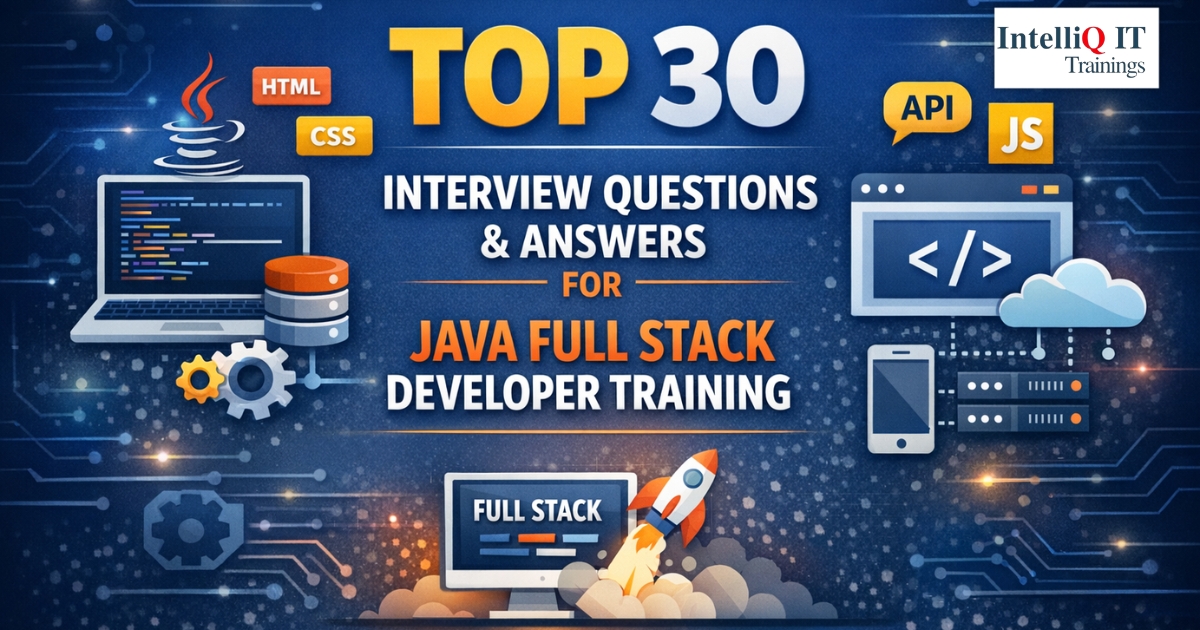
The demand for Java Full Stack Developers will persist in 2026 because organizations in all sectors pay emphasis on developing scalable, secure, and high-performance web applications. Full stack development is one of the most well-rewarding careers in the IT industry, as companies are aggressively recruiting professionals who are capable of managing the frontend and the backend technology. Java Full Stack Developers are important in the development of end-to-end applications because they design responsive user interfaces and create robust server-side code and database management.
When you are planning to attend job interviews after finishing a course on Java Full Stack Developer, it is necessary to understand both the technical knowledge and real-life application cases. In this blog, the author will be combining the 30 best Java Full Stack interview questions and answers that are commonly posed by recruiters by 2026. These questions are based on the following core areas, which include the use of CoreJava, Spring Boot, REST APIs, frontend frameworks, and databases, as well as deployment tools.
Is the interview for the first job that you are doing, or are you a veteran professional seeking a superior position? These interview questions will assist you in updating on crucial issues, enhance your self-confidence, and excel in technical interviews.
🔹 Core Java Interview Questions
1. What is Java Full Stack Development?
Java Full Stack Development requires developers to create entire web applications through frontend development with HTML, CSS, JavaScript, and React or Angular and backend development with Core Java and Spring and Spring Boot and database management and deployment tools.
2. What are the main components of a Java full-stack application?
- Frontend (UI layer)
- Backend (Business logic)
- Database
- Server & deployment tools
3. What are JVM, JRE, and JDK?
- JVM: Executes Java bytecode
- JRE: JVM + libraries
- JDK: JRE + development tools
4. What is OOPs in Java?
OOPs includes:
- Encapsulation
- Inheritance
- Polymorphism
- Abstraction
5. Difference between Abstract Class and Interface?
| Abstract Class | Interface |
| Can have method implementation | Only method declarations (Java 8 allows default methods) |
| Supports constructors | No constructors |
| Supports variables | Only constants |
🔹 Advanced Java & Backend Questions
6. What is Spring Framework?
Spring functions as a lightweight Java framework that enables enterprise application development through its core features of dependency injection and aspect-oriented programming.
7. What is Spring Boot?
Spring Boot simplifies Spring application development by:
- Reducing configuration
- Providing embedded servers
- Enabling rapid development
8. Difference between Spring and Spring Boot?
Spring needs developers to handle configuration tasks manually, but Spring Boot provides automatic configuration, which accelerates the development process.
9. What is a REST API?
REST (Representational State Transfer) is an architectural style used to build scalable web services using HTTP methods like GET, POST, PUT, and DELETE.
10. What is Hibernate?
Hibernate is an ORM (Object Relational Mapping) tool that maps Java objects to database tables and reduces SQL coding.
🔹 Frontend Interview Questions
11. What is HTML5?
HTML5 is the latest version of HTML used to structure web pages with semantic elements like <header>, <footer>, and <section>.
12. Difference between CSS and Bootstrap?
- CSS: Custom styling
- Bootstrap: Predefined CSS framework for responsive design
13. What is JavaScript?
JavaScript is a client-side scripting language used to make web pages interactive.
14. What is React?
React is a JavaScript library used to build dynamic and reusable UI components.
15. Difference between React and Angular?
- React is a library
- Angular is a full framework
- React uses Virtual DOM, Angular uses Real DOM
🔹 Database & SQL Questions
16. What is SQL?
SQL (Structured Query Language) is used to manage and manipulate relational databases.
17. Difference between DELETE and TRUNCATE?
- DELETE removes selected rows
- TRUNCATE removes all rows and resets identity
18. What is normalization?
Normalization reduces data redundancy by organizing database tables efficiently.
19. What is a primary key?
A primary key uniquely identifies each record in a database table.
20. Difference between WHERE and HAVING?
- WHERE filters rows
- HAVING filters group data
🔹Tools, DevOps & Deployment Questions
21. What is Git?
Git is a version control system used to track code changes and collaborate with teams.
22. What is Maven?
Maven is a build automation tool used to manage dependencies and project structure.
23. What is CI/CD?
CI/CD automates code integration, testing, and deployment, improving development speed.
24. What is Docker?
Docker is a containerization tool that packages applications with dependencies for consistent deployment.
25. What is Agile methodology?
Agile is an iterative development approach focusing on continuous improvement and customer feedback.
🔹 Scenario-Based & Career Questions
26. How do you handle exceptions in Java?
Using the try, catch, finally, throw, and throws keywords.
27. What is dependency injection?
Dependency injection allows objects to be provided externally rather than created internally, improving loose coupling.
28. What are microservices?
Microservices break applications into small, independent services that communicate via APIs.
29. What projects have you worked on as a Java Full Stack Developer?
Explain real-time projects involving frontend, backend, database, and deployment.
30. Why should we hire you as a Java Full Stack Developer?
Highlight:
- Strong Java & frontend skills
- Hands-on project experience
- Problem-solving ability
- Willingness to learn
🚀 Final Thoughts
The Top 30 Java Full Stack interview questions and answers will serve you well when you prepare for your 2026 interviews and need to demonstrate clear technical knowledge. Theoretical knowledge needs to be supported by actual work with real projects to show your practical abilities during job interviews. Recruiters search for candidates who can show their understanding of concepts through explanations and their ability to apply these concepts to actual job situations.
The Java Full Stack Developer Training at IntelliQ IT Trainings provides industry-standard education, which enables students to create a solid base for their career advancement. The educational program provides students with practical training through real-world projects, expert mentorship, and job placement assistance, benefiting both entry-level candidates and current workers who want to enhance their Java Full Stack interview preparation skills.